New & Noteworthy
New Pathway Pages: Comprehensive Views of Yeast Biochemical Pathways
August 11, 2026
We’re excited to announce the release of Pathway Pages at SGD! These new pages provide comprehensive information about the 220 manually curated biochemical pathways in yeast, bringing together pathway diagrams, gene lists, functional networks, and curated experimental data all in one place.
- One-stop resource: All pathway information in a single place
- Rich context: See genes in the context of the pathway they participate in
- Evidence-based: All data tied to primary literature
- Interactive exploration: Multiple ways to explore pathway relationships
Pathway pages offer a complete view of specific biochemical pathways in Saccharomyces cerevisiae. Each page integrates information from multiple sources to help you understand what the pathway does, which genes are involved, how gene products interact, and which chemicals are involved.
What’s Included?
Interactive Pathway Diagrams
Each pathway page features a pathway diagram showing the chemical reactions and metabolic flow. The diagram displays:
- Chemical compounds involved (substrates and products)
- Enzymes catalyzing each reaction
- Reaction directionality and relationships

A “View interactive diagram at YeastPathways” button takes you to the full interactive version where you can explore the pathway in greater detail.
Pathway Summary
Expert-curated descriptive text explains:
- What the pathway does and why it’s important
- Biological context and cellular roles
- Connections to other metabolic processes
- Key regulatory mechanisms
For example, the glyoxylate cycle page explains how this essential pathway allows yeast to grow on two-carbon compounds and its role in providing precursors for biosynthesis.
Genes Involved
A comprehensive table of genes participating in the pathway includes:
- Gene names (standard and systematic)
- EC numbers for enzymatic activities
- Functional descriptions
- Direct links to gene pages for detailed information
This makes it easy to see all the players in a pathway at a glance and dive deeper into any gene of interest.
Functional Networks
Pathway pages now include the same Functional Networks features available on gene pages:

Shared Annotations Network: Visualizes how genes in the pathway share phenotype and GO annotations, helping you identify:
- Functional relationships between pathway genes
- Connections to genes in related pathways
- Potential regulatory relationships
You can filter the network by the number of shared pathway genes to focus on the most relevant connections.
GO-CAMs: When available, Gene Ontology Causal Activity Model pathway models are displayed, showing:
- Causal relationships between molecular activities
- How gene products work together mechanistically
- Regulatory interactions and dependencies

If multiple GO-CAM models involve genes from the pathway, you can switch between them using a dropdown menu.
GO Enrichment Analysis
The GO Enrichment section shows which biological processes are statistically overrepresented among pathway genes. This helps you:
- Understand the broader biological context
- See connections to related processes
- Identify key functional themes
Each enriched term links to the genes involved and shows the statistical significance (p-value).
Browse All Pathways
Explore all 220 curated pathways:
- Browse pathways: Search for pathways
- Example: Glyoxylate cycle
- YeastPathways: All metabolic pathways
We Want Your Feedback!
Pathway pages are a new addition to SGD, and we want to make them as useful as possible. Have suggestions? Questions about specific pathways? Let us know at sgd-helpdesk@lists.stanford.edu.
Categories: Announcements, Website changes
Tags: biochemical pathways, GO enrichment, GO-CAM, metabolic pathways, pathway diagrams, YeastPathways
Redesigned Protein Complex Pages: Enhanced Data Access and Improved User Experience
August 04, 2026
We’re excited to announce a comprehensive redesign of SGD’s macromolecular complex pages! We’ve overhauled these pages to make complex information more accessible, comprehensive, and easier to navigate.
Why Protein Complexes Matter
Protein complexes are fundamental functional units in cells that operate as groups of proteins that work together to carry out specific biological processes. Since 2019, SGD has provided detailed information about yeast protein complexes, including subunit composition, functions, interactions, and references. With this major redesign, we’ve made this critical information even more accessible and useful for researchers.
What’s New?
All Gene Ontology Information on One Page
One of the most significant improvements is the reorganization of Gene Ontology (GO) annotations. Previously, GO information was tucked away on a separate tab, requiring you to navigate away from the main view. Now, all GO annotations are prominently displayed right on the Summary page.
What you can see at a glance:
- Molecular Function: What the complex does
- Biological Process: What pathways or processes it participates in
- Cellular Component: Where in the cell it’s located
No more tab-switching—everything you need is in one place!
GO-CAM Pathway Models for Complexes
We’ve also integrated GO-CAM (Gene Ontology Causal Activity Models) pathway models directly into complex pages. When available, these models appear below the GO annotations, showing how entire protein complexes fit into larger biological pathways and regulatory networks. This provides a systems-level view that complements the detailed subunit information available on individual gene pages.

Enhanced Composition Section
The new Composition section is packed with detailed subunit information:
Stoichiometry Data: For complexes where the subunit ratios have been experimentally determined, you’ll now see the exact stoichiometry. This quantitative information is crucial for understanding complex architecture.
Structural Information:
- Expert-curated notes about complex assembly and structural features
- Direct links to Protein Data Bank (PDB) entries for complexes with experimentally determined 3D structures
- Protein-protein binding regions and interaction interfaces (when characterized)
Organized Display: Subunits are now grouped by their roles or relationships within the complex, making it easier to understand how the complex is organized.
Easy Navigation: Each subunit links directly to its SGD gene page, so you can quickly dive deeper into individual components.

Shared Biology Networks
Complex pages now include a Shared Biology section that shows:
- GO annotations shared with other complexes
- Subunits shared between complexes
- Ranked lists that prioritize the most functionally related complexes
The ranking system helps you quickly identify the most relevant relationships and potential functional connections, making it easier to understand how different complexes relate to each other.

Improved User Experience Throughout
Beyond these major features, we’ve focused on overall usability:
- Clearer section headers make information easy to find
- Better spacing and organization improve readability
- Consistent styling with other SGD page types provides a unified experience
- Logical information hierarchy puts the most commonly accessed data front and center
Try It Out!
Explore the new complex pages:
- Example: Sulfite reductase complex (NADPH)
- Browse all complexes: Search for complexes
We Want Your Feedback!
These improvements are based on feedback from the yeast research community, and we want to keep making SGD better. Have suggestions? Questions? Let us know at sgd-helpdesk@lists.stanford.edu.
Categories: Announcements, Website changes
Tags: Gene Ontology, GO annotations, GO-CAM, protein complexes, redesign, stoichiometry, UI, user experience, UX
Functional Networks: A New Way to Explore Gene Relationships at SGD
August 03, 2026
We’re excited to announce new Functional Networks sections on gene and complex pages! This powerful addition helps researchers understand how genes and proteins work together in biological systems.
What Are Functional Networks?
The new Functional Networks section appears on most gene page, positioned just below the Gene Ontology section. It provides two complementary views of how gene products interact and function together:
1. Shared Annotations Networks
Ever wondered which other genes might have similar functions to your gene of interest? The Shared Annotations network visualizes genes that share similar Gene Ontology (GO) annotations with your query gene. These networks are generated based on overlapping GO terms across Molecular Function, Biological Process, and Cellular Component.

Why is this useful?
- Identify potential interaction partners
- Find paralogs with related functions
- Discover genes that may participate in similar biological processes
- Generate hypotheses for experimental design
Most genes in the S. cerevisiae genome have sufficient GO annotations to generate these networks, providing broad coverage across the yeast proteome.
2. GO-CAM Pathway Models
GO-CAMs (Gene Ontology Causal Activity Models) represent an exciting advancement in pathway representation. Unlike traditional GO annotations that link individual genes to single terms, GO-CAMs show how multiple gene products work together in integrated pathway models.

What makes GO-CAMs special?
- Causal relationships: See how one molecular activity leads to another, including activation, inhibition, and regulatory interactions
- Integrated view: Combines Molecular Function, Biological Process, and Cellular Component information in one unified model
- Evidence-based: All models are manually curated by expert biologists and supported by published experimental data
Currently, 470 yeast genes are associated with GO-CAM models, and this number continues to grow as additional pathways are curated.
When multiple GO-CAM models are available for a gene, you can easily switch between them using a pull-down menu. Each model includes a “View GO-CAM at Gene Ontology” link that opens the interactive pathway in AmiGO, where you can explore detailed evidence codes, supporting references, and connections to other pathways.
Functional Networks on Complex Pages
We’ve also added a Shared Biology section to macromolecular complex pages. This section shows:
- GO annotations shared with other complexes
- Subunits shared between complexes
- A ranked list summarizing these relationships
This helps researchers understand how protein complexes relate to each other and identify functionally similar complexes.

How to Access
Simply navigate to any gene page at SGD and scroll to the Functional Networks section (located beneath Gene Ontology). For complex pages, look for the Shared Biology section.
Try it out:
- Example gene page: https://www.yeastgenome.org/locus/MET2
- Example complex page: https://www.yeastgenome.org/complex/CPX-3163
Part of a Bigger Picture
The GO-CAM display on SGD gene pages replicates the implementation from the Alliance of Genome Resources, providing a consistent user experience across model organism databases. This integration reflects our commitment to making yeast data accessible and interoperable with other genomic resources.
We Want Your Feedback!
This new feature is designed to help you explore gene relationships and generate hypotheses more effectively. We’d love to hear what you think! Contact us at sgd-helpdesk@lists.stanford.edu with your feedback or questions.
Categories: Announcements, Website changes
Tags: functional networks, gene annotation, GO-CAM, protein complexes, shared annotations
Introducing BLAST Search for SGD at the Alliance of Genome Resources
February 17, 2026

We’re excited to announce the launch of a new BLAST service for Saccharomyces Genome Database (SGD) data, now available at the Alliance of Genome Resources. This release marks another significant milestone in our ongoing effort to migrate SGD services and data to the Alliance platform, ensuring continued access to essential yeast genomics tools within an integrated, multi-organism framework.
What’s New
The Alliance BLAST service provides researchers with powerful sequence similarity search capabilities against SGD datasets, maintaining the functionality that the yeast research community has relied on for years while benefiting from the Alliance’s modern infrastructure and cross-species integration.
Key Features
- Comprehensive SGD datasets: Search against the complete S. cerevisiae genome, including coding sequences, proteins, and genomic DNA, or search against genomes from dozens of other strains
- Familiar BLAST functionality: All standard BLAST algorithms (BLASTN, BLASTP, BLASTX, TBLASTN, TBLASTX) are supported
- Enhanced performance: Leveraging the Alliance’s updated infrastructure for faster search results
- Cross-species exploration: Seamlessly explore homologs across other Alliance member databases
Part of a Broader Migration
This BLAST service is part of our comprehensive strategy to transition SGD resources to the Alliance of Genome Resources. This migration ensures that:
- SGD data remains accessible and well-maintained for the research community
- Users benefit from integration with data from other model organisms
- Resources are consolidated on a sustainable, collaborative platform
- The yeast community gains access to enhanced comparative genomics tools
Getting Started
Visit the Alliance of Genome Resources to access the new service for SGD BLAST, including Fungal BLAST. The datasets will be familiar to longtime SGD users.
Looking Ahead
We remain committed to supporting the yeast research community through this transition. Additional SGD tools and features will continue to migrate to the Alliance platform in the coming months. Stay tuned for updates, and as always, we welcome your feedback.
Categories: Announcements
Give a Gift / Support SGD
January 31, 2025
Giving to SGD just got easier! We now accept donations by credit card with this form: give.stanford.edu.
Select ‘Other Stanford Designation’ under ‘Direct your gift’ & in the ‘Other’ box, add: Saccharomyces Genome Database – Account: GHJKO, Genetics: WAZC. Thanks for your support!
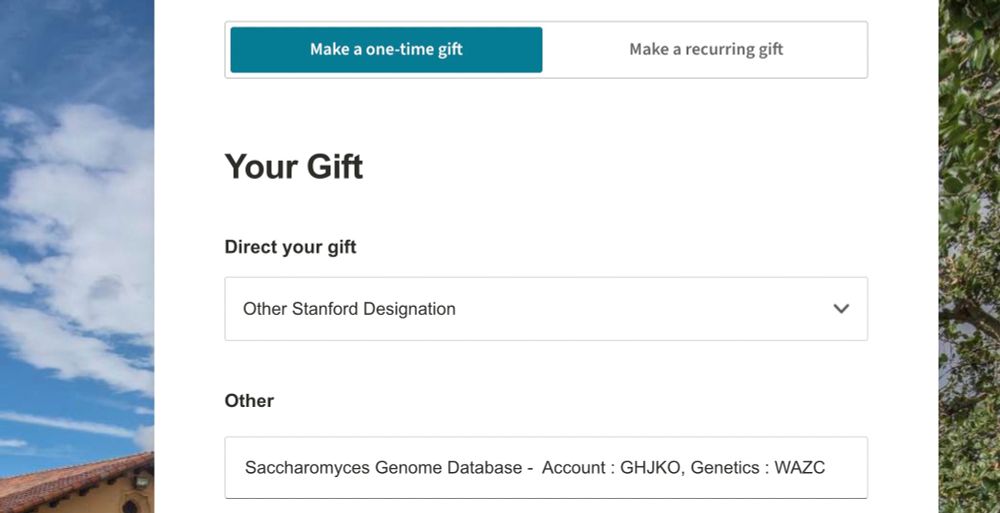
Your generous gift to SGD enables us to continue providing essential information for your research and teaching efforts. Donations are now critical for our work to continue.
To contribute via check, please make checks payable to Stanford University, and include a note stating that “these funds should be used to support the Saccharomyces Genome Database project in the Department of Genetics, Stanford University. Account : GHJKO, Genetics : WAZC.”
Thank you for your support!
Kindly send by mail to:
Development Services
PO Box 20466
Stanford, CA 94309
CONTACT US:
sgd-helpdesk@lists.stanford.edu
Categories: Announcements
AlphaFold protein structures now on SGD protein pages
November 18, 2024
We are thrilled to announce that we have now integrated AlphaFold protein structures into our protein pages! This cutting-edge addition provides detailed, high-accuracy 3D models of protein structures, offering invaluable insights into protein function and interactions. Researchers can now explore these comprehensive structural predictions directly within SGD, facilitating advanced studies in molecular biology and bioinformatics. Dive into the new AlphaFold protein structures and elevate your research with this powerful tool!

AlphaFold, developed by DeepMind, is an AI program that accurately predicts protein structures from amino acid sequences, enabling visualization of protein conformations. The predicted structures can be accessed through the Protein Data Bank (PDB) and AlphaFold Protein Structure Database.
Thanks to Kim Rutherford and Val Wood of Pombase for tips about adding AlphaFold structures to SGD.
Categories: Announcements
YeastMine shutting down July 15
July 01, 2024
Due to ongoing cuts to our funding, SGD can no longer continue to provide the YeastMine data warehouse resource. It is with heavy hearts that we discontinue this service.
Back in 2011, SGD implemented InterMine (http://www.InterMine.org), an open source data warehouse system with a sophisticated querying interface, to create YeastMine, a multifaceted search and retrieval environment that provided access to diverse data types. YeastMine served as a powerful search interface, a discovery tool, a curation aid, and a complex database presentation format.
YeastMine has served us all quite well. We are working to move the YeastMine data into AllianceMine, hosted by the Alliance of Genome Resources, of which SGD is a founding member.
To get started with AllianceMine, go to the Templates page, and filter by category = ‘YeastMine’.

Categories: Announcements
New user interface for YeastMine
April 04, 2024
Here at SGD we provide high-quality curated genomic, genetic, and molecular information on the genes and gene products of the budding yeast Saccharomyces cerevisiae. Twelve years ago, in order to accommodate the increasingly complex and diverse needs of researchers for searching and comparing data, SGD implemented InterMine, an open source data warehouse system with a sophisticated querying interface, to create YeastMine.
Today’s news is that we have updated YeastMine to use the new BlueGenes user interface from InterMine. The new interface provides the same functionality you’re already familiar with, wrapped in a new design offering a more interactive experience for exploring and analyzing your data. We are making this switch because AllianceMine at the Alliance of Genome Resources, of which SGD is a founding member, is using the updated interface as well.

YeastMine is a multifaceted search and retrieval environment that provides access to diverse data types. Searches can be initiated with a list of genes, a list of Gene Ontology terms, or lists of many other data types. The results from queries can be combined for further analysis and saved or downloaded in customizable file formats. Queries themselves can be customized by modifying predefined templates or by creating a new template to access a combination of specific data types.
User documentation for the new YeastMine interface is available from InterMine.
Categories: Announcements
Tags: user-interface
Changes to Saccharomyces cerevisiae GFF3 file
March 01, 2024
The saccharomyces_cerevisiae.gff contains sequence features of Saccharomyces cerevisiae and related information such as Locus descriptions and GO annotations. It is fully compatible with Generic Feature Format Version 3. It is updated weekly.
After November 2020, SGD updated the transcripts in the GFF file to reflect the experimentally determined transcripts (Pelechano et al. 2013, Ng et al. 2020), when possible. The longest transcripts were determined for two different growth media – galactose and dextrose. When available, experimentally determined transcripts for one or both conditions were added for a gene. When this data was absent, transcripts matching the start and stop coordinates of an open reading frame (ORF) were used.

Beginning in February 2024, SGD increased the start and stop coordinates of genes to encompass the start and stop coordinates of the longest experimentally determined transcripts, regardless of condition. This change was made in order to comply with JBrowse 2, a newer and more extensible genome browser, which requires that parent features in GFF files (genes) are larger than child features (mRNA, CDS, etc) (Diesh et al., 2023).

This is a standard format used by many groups. SGD uses the GFF file to load the reference tracks in SGD’s genome browser resource.
Categories: Announcements, Data updates
Tags: biology, blog, genetics, news, Saccharomyces cerevisiae
Search full-text with Textpresso: new papers added weekly
December 06, 2023
SGD’s instance of Textpresso has recently been updated! Each week, SGD biocurators triage new publications from PubMed to load the newest yeast papers into the database. Once they are in SGD, those papers get indexed and loaded into Textpresso – a tool for full-text mining and searching. This is the new part: Content updates in SGD’s Textpresso are now happening on a weekly basis, meaning you can search full text of the very latest yeast papers!

You already love Textpresso for searching full text and its other bells and whistles:
- Search results shown in the context of the full text – hits to query terms highlighted in situ
- Custom corpus creation – you can decide which papers to search
- Search using Boolean operators
- Search scope options for document or sentence
- Search location options can constrain to specific sections of papers

Textpresso can be accessed via the “Full-text Search” link under “Literature” in the purple toolbar that runs across the top of most SGD webpages. Now you can search full text of the very latest yeast papers each week!
Categories: Announcements