ATM1 / YMR301C Overview
- Standard Name
- ATM1 1
- Systematic Name
- YMR301C
- SGD ID
- SGD:S000004916
- Feature Type
- ORF , Verified
- Description
- Mitochondrial inner membrane ATP-binding cassette (ABC) transporter; exports mitochondrially synthesized precursors of iron-sulfur (Fe/S) clusters to the cytosol; human homolog ABCB7 can complement yeast null mutant 1 2 3 4
- Name Description
- ABC Transporter of Mitochondria 1
- Comparative Info
-







Sequence
The S. cerevisiae Reference Genome sequence is derived from laboratory strain S288C. Download DNA or protein sequence, view genomic context and coordinates. Click "Sequence Details" to view all sequence information for this locus, including that for other strains.
- Summary
- ATM1/YMR031C is located on the right arm of chromosome XIII near the telomere between ADE4 phosphoribosylpyrophosphate amidotransferase and YME2 inner mitochondrial membrane protein; coding sequence is 2073 nucleotides long with 14 SNPs, 3 of which cause amino acid polymorphisms
Analyze Sequence
S288C only
BLASTN | BLASTP | Design Primers | Restriction Fragment Map | Restriction Fragment Sizes | Six-Frame Translation
S288C vs. other species
BLASTN vs. fungi | BLASTP at NCBI | BLASTP vs. fungi | CGD Synteny Browser
S288C vs. other strains
Protein
Basic sequence-derived (length, molecular weight, isoelectric point) and experimentally-determined (median abundance, median absolute deviation) protein information. Click "Protein Details" for further information about the protein such as half-life, abundance, domains, domains shared with other proteins, protein sequence retrieval for various strains, physico-chemical properties, protein modification sites, and external identifiers for the protein.
- Summary
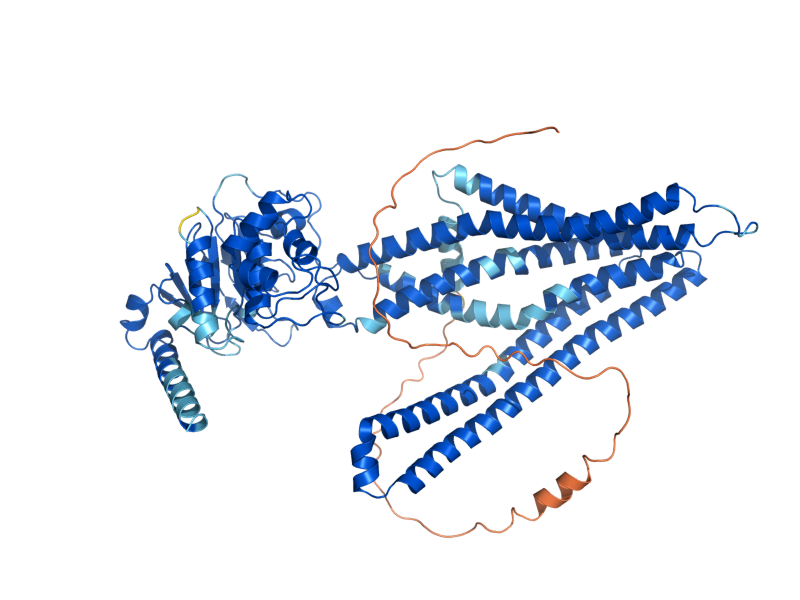
- Atm1p is 690 amino acids long, of average half-life, low in abundance; phosphorylated on S63, succinylated on K62 and K72
Alleles
Curated mutant alleles for the specified gene, listed alphabetically. Click on the allele name to open the allele page. Click "SGD search" to view all alleles in search results.
View all ATM1 alleles in SGD search
Gene Ontology
GO Annotations consist of four mandatory components: a gene product, a term from one of the three Gene Ontology (GO) controlled vocabularies (Molecular Function, Biological Process, and Cellular Component), a reference, and an evidence code. SGD has manually curated and high-throughput GO Annotations, both derived from the literature, as well as computational, or predicted, annotations. Click "Gene Ontology Details" to view all GO information and evidence for this locus as well as biological processes it shares with other genes.
- Summary
- ATP-binding cassette (ABC) transporter with ATPase activity; involved in transport of Fe/S clusters to cytosol; localized to mitochondrial inner membrane
View computational annotations
Molecular Function
- Manually Curated
Biological Process
- Manually Curated
- involved in iron-sulfur cluster assembly (IMP)
- acts upstream of or within iron-sulfur cluster transmembrane transport (IMP)
Cellular Component
- Manually Curated
- located in mitochondrial inner membrane (IDA)
- High-Throughput
- located in mitochondrion (HDA)
Phenotype
Phenotype annotations for a gene are curated single mutant phenotypes that require an observable (e.g., "cell shape"), a qualifier (e.g., "abnormal"), a mutant type (e.g., null), strain background, and a reference. In addition, annotations are classified as classical genetics or high-throughput (e.g., large scale survey, systematic mutation set). Whenever possible, allele information and additional details are provided. Click "Phenotype Details" to view all phenotype annotations and evidence for this locus as well as phenotypes it shares with other genes.
- Summary
- Null mutants are inviable under standard aerobic conditions, viable but slow-growing under anaerobic conditions; null mutant cells accumulate glutathione disulfide, and mitochondria contain increased levels of free iron; heterozygous diploid nulls are haploinsufficient, sensitive to starvation and to the Sir2 histone deacetylase inhibitor tenovin-6; reduced function mutants show increased competitive fitness and chromosome instability
Classical Genetics
- null
- reduction of function
- conditional
Large-scale Survey
Disease
Disease Annotations consist of three mandatory components: a gene product, a term from the Disease Ontology (DO) controlled vocabulary and an evidence code. SGD provides manually curated DO Annotations derived from the literature. Click "Disease Details" to view all Disease information and evidence for this locus as well as diseases it shares with other genes.
- Summary
- Yeast ATM1 is homologous to human ABCB7 and has been used to study X-linked sideroblastic anemia with ataxia
Manually Curated
Interaction
Interaction annotations are curated by BioGRID and include physical or genetic interactions observed between at least two genes. An interaction annotation is composed of the interaction type, name of the interactor, assay type (e.g., Two-Hybrid), annotation type (e.g., manual or high-throughput), and a reference, as well as other experimental details. Click "Interaction Details" to view all interaction annotations and evidence for this locus, including an interaction visualization.
- Summary
- Atm1p interacts physically with proteins involved in organelle organization and RNA catabolism; ATM1 interacts genetically with genes involved in transcription
153 total interactions for 150 unique genes
Regulation
The number of putative Regulators (genes that regulate it) and Targets (genes it regulates) for the given locus, based on experimental evidence. This evidence includes data generated through high-throughput techniques. Click "Regulation Details" to view all regulation annotations, shared GO enrichment among regulation Targets, and a regulator/target diagram for the locus.
- Summary
- ATM1 encodes an ATP-binding cassette (ABC) transporter of the mitochondrial inner membrane that is essential for assembly of cytosolic-nuclear iron/sulfur (Fe/S) clusters. Fe/S cluster-containing proteins are key components in multiple metabolic pathways, where they serve as electron carriers in a variety of redox reactions, donors of iron or sulfur in enzymatic reactions, or sensors of the cellular redox state. The assembly of Fe/S proteins takes place in both the mitochondria and the cytosol, but the elemental sulfur for all Fe/S clusters originates inside mitochondria, where it is generated from cysteine by the cysteine desulfurase complex Nfs1p-Isd11p. For assembly of cytosolic-nuclear Fe/S clusters, the mitochondrial Fe/S cluster assembly machinery generates an as yet unidentified sulfur-containing compound that is subsequently exported to the cytoplasm by Atm1p and used by the cytosolic Fe/S protein assembly (CIA) system. Atm1p binds and requires glutathione for its activity. The transmembrane transport by Atm1p is also known to require the sulfhydryl oxidase Erv1p in the mitochondrial intermembrane space and possibly other components. The ATPase activity of Atm1p and hydrolysis of ATP is presumably needed for opening the channel or driving the substrate through it. Despite the substantial amount of information, the exact mechanism of this transport and the precise role of Atm1p or how it is regulated remain unknown. ATM1 is highly conserved throughout evolution. The human ortholog ABCB7, which complements yeast atm1 mutants, is also involved in cytosolic Fe/S protein functions and its deficiencies cause X-linked sideroblastic anemia and cerebellar ataxia (XLSA/A).
Expression
Expression data are derived from records contained in the Gene Expression Omnibus (GEO), and are first log2 transformed and normalized. Referenced datasets may contain one or more condition(s), and as a result there may be a greater number of conditions than datasets represented in a single clickable histogram bar. The histogram division at 0.0 separates the down-regulated (green) conditions and datasets from those that are up-regulated (red). Click "Expression Details" to view all expression annotations and details for this locus, including a visualization of genes that share a similar expression pattern.
Summary Paragraph
A summary of the locus, written by SGD Biocurators following a thorough review of the literature. Links to gene names and curated GO terms are included within the Summary Paragraphs.
Last Updated: 2025-01-22
All Curated Literature
All manually curated literature for the specified gene, shown as a count of references by year of publication followed by the most recent papers. Click "Literature Details" or "See all" to view all literature information for this locus, organized into topics according to their relevance to the gene (Primary Literature, Additional Literature, or Review).
Loading literature…