Pathway: periplasmic NAD degradation
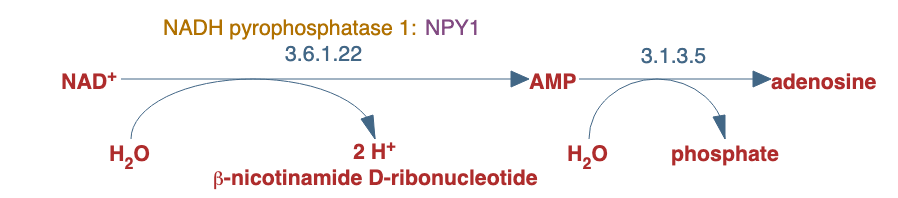
Biochemical pathways in S. cerevisiae are manually curated and maintained in the YeastPathways database. This page summarizes the genes, enzymes, and metabolites involved in the pathway, along with the curated literature.
- Pathway Name
- periplasmic NAD degradation
- Pathway ID
- PERIPLASMA-NAD-DEGRADATION
- SGD ID
- SGD:S000249659
- Genes
- NPY1
- Chemical Compounds
- NAD(1-) | NMN(-) | adenosine | adenosine 5'-monophosphate(2-) | hydrogenphosphate | hydron | water
Pathway Summary
Extracellular metabolism of NMN, but not NAD+, is known to occur in S. cerevisiae. This occurs via Pho5p, the major secreted acid phosphatase in yeast. Pho5p catalyzes the conversion of exogenous NMN in the periplasm to nicotinamide riboside (NR), a NAD+ precursor that can be imported into the cell and converted back to NAD+ via salvage pathways. Deletion of PHO5 prevents growth of a mutant disrupted in the NAD+ biosynthesis pathway on medium containing NMN. In addition to Pho5p, two other enzymes are known to play a role in catabolizing extracellular nucleotides in S. cerevisiae: the nucleotide pyrophosphatasesphosphodiesterases Npp1p and Npp2p. Both yeast enzymes belong to a superfamily of alkaline phosphatases that also includes extracellular 5-nucleotidases from mammals.
Genes Involved
Genes whose products participate in this pathway, with their systematic names, EC numbers (where the gene product is an enzyme with an assigned EC number), and the gene's SGD description.
| Gene | Systematic Name | EC Number | Description |
|---|---|---|---|
| NPY1 | YGL067W | 3.6.1.22 | NADH diphosphatase (pyrophosphatase) |
Functional Networks
Functional Networks show how the genes in this pathway work together: a graph linking the pathway to its genes and their shared GO biological-process terms and phenotype observables, and the GO-CAM causal activity models that involve these genes.
Shared Annotations
GO-CAMs
GO-CAM (Gene Ontology Causal Activity Model) pathway models that involve the genes in this pathway. A gene can participate in more than one model, so use the dropdown to switch between them; the model for this pathway is shown by default.
References
List of references used specifically to curate the information on this page.
- Lu SP, et al. (2009) Assimilation of endogenous nicotinamide riboside is essential for calorie restriction-mediated life span extension in Saccharomyces cerevisiae. J Biol Chem 284(25):17110-17119 PMID: 19416965
- Kennedy EJ, et al. (2005) Pho5p and newly identified nucleotide pyrophosphatases/ phosphodiesterases regulate extracellular nucleotide phosphate metabolism in Saccharomyces cerevisiae. Eukaryot Cell 4(11):1892-901 PMID: 16278456
Resources
YeastPathways