Pathway: superpathway of histidine, purine, and pyrimidine biosynthesis
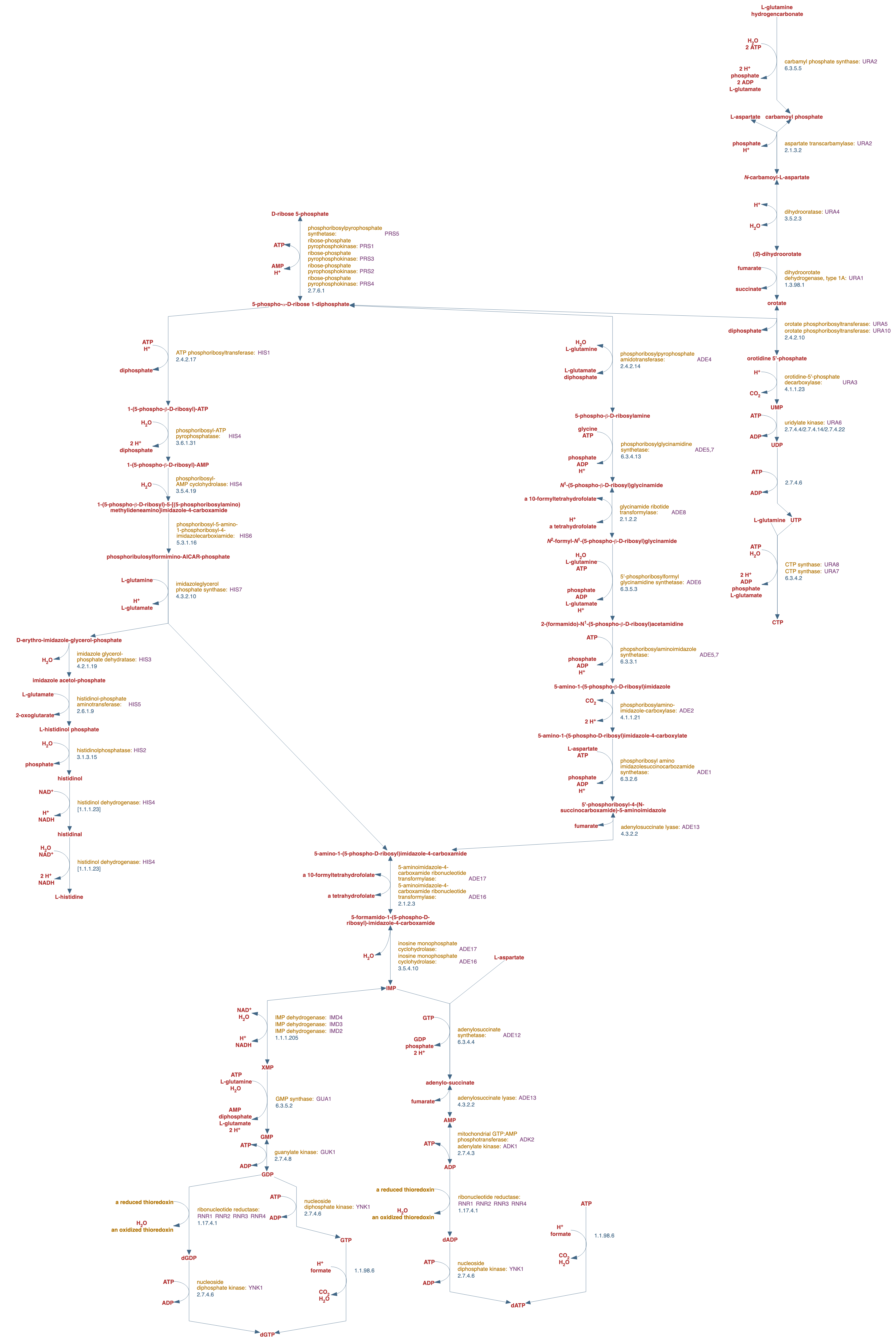
Biochemical pathways in S. cerevisiae are manually curated and maintained in the YeastPathways database. This page summarizes the genes, enzymes, and metabolites involved in the pathway, along with the curated literature.
- Pathway Name
- superpathway of histidine, purine, and pyrimidine biosynthesis
- Pathway ID
- PRPP-PWY-1
- SGD ID
- SGD:S000249734
- Genes
- ADE1 | ADE12 | ADE13 | ADE16 | ADE17 | ADE2 | ADE4 | ADE6 | ADE8 | ADK1 | ADK2 | GUA1 | GUK1 | HIS1 | HIS2 | HIS3 | HIS4 | HIS5 | HIS6 | HIS7 | IMD2 | IMD3 | IMD4 | PRS1 | PRS2 | PRS3 | PRS4 | PRS5 | RNR1 | RNR2 | RNR3 | RNR4 | TRX1 | TRX2 | TRX3 | URA1 | URA10 | URA2 | URA3 | URA4 | URA5 | URA6 | URA7 | URA8 | YNK1
- Chemical Compounds
- (S)-dihydroorotate | 1-(5-phospho-beta-D-ribosyl)-5-[(5-phospho-beta-D-ribosylamino)methylideneamino]imidazole-4-carboxamide(4-) | 1-(5-phospho-beta-D-ribosyl)-ATP | 1-(5-phosphonato-beta-D-ribosyl)-5'-AMP(4-) | 2-formamido-N(1)-(5-phospho-D-ribosyl)acetamidine | 2-oxoglutarate(2-) | 3-(imidazol-4-yl)-2-oxopropyl phosphate(2-) | 5'-xanthylate(2-) | 5-O-phosphonato-alpha-D-ribofuranosyl diphosphate(5-) | 5-[(5-phospho-1-deoxy-D-ribulos-1-ylimino)methylamino]-1-(5-phospho-beta-D-ribosyl)imidazole-4-carboxamide(4-) | 5-amino-1-(5-phospho-D-ribosyl)imidazole-4-carboxamide(2-) | 5-amino-1-(5-phosphonato-D-ribosyl)imidazole-4-carboxylate | 5-amino-1-(5-phosphonato-beta-D-ribosyl)imidazol-3-ium | 5-formamido-1-(5-phospho-D-ribosyl)imidazole-4-carboxamide(2-) | 5-phospho-beta-D-ribosylaminium(1-) | ADP(3-) | ATP(4-) | CTP(4-) | D-erythro-1-(imidazol-4-yl)glycerol 3-phosphate(2-) | D-ribofuranose 5-phosphate(2-) | GDP(3-) | GTP(4-) | IMP(2-) | L-aspartate(1-) | L-glutamate(1-) | L-glutamine zwitterion | L-histidinal(1+) | L-histidine zwitterion | L-histidinol phosphate(1-) | L-histidinol(1+) | N(1)-(5-phospho-D-ribosyl)glycinamide(1-) | N(2)-formyl-N(1)-(5-phospho-D-ribosyl)glycinamide(2-) | N(6)-(1,2-dicarboxylatoethyl)-AMP(4-) | N-carbamoyl-L-aspartate(2-) | NAD(1-) | NADH(2-) | SAICAR(4-) | UDP(3-) | UTP(4-) | adenosine 5'-monophosphate(2-) | ammonium | carbamate | carbamoyl phosphate(2-) | carbon dioxide | carboxyphosphate(2-) | dADP(3-) | dATP(4-) | dGDP(3-) | dGTP(4-) | diphosphoric acid | formate | fumarate(2-) | glycine zwitterion | guanosine 5'-monophosphate(2-) | hydrogencarbonate | hydrogenphosphate | hydron | orotate | orotidine 5'-phosphate(3-) | succinate(2-) | uridine 5'-monophosphate(2-) | water
Genes Involved
Genes whose products participate in this pathway, with their systematic names, EC numbers (where the gene product is an enzyme with an assigned EC number), and the gene's SGD description.
| Gene | Systematic Name | EC Number | Description |
|---|---|---|---|
| ADE1 | YAR015W | 6.3.2.6 | N-succinyl-5-aminoimidazole-4-carboxamide ribotide synthetase |
| ADE12 | YNL220W | 6.3.4.4 | Adenylosuccinate synthase |
| ADE13 | YLR359W | 4.3.2.2 | Adenylosuccinate lyase |
| ADE16 | YLR028C | 2.1.2.3, 3.5.4.10 | Enzyme of 'de novo' purine biosynthesis |
| ADE17 | YMR120C | 2.1.2.3, 3.5.4.10 | Enzyme of 'de novo' purine biosynthesis |
| ADE2 | YOR128C | 4.1.1.21 | Phosphoribosylaminoimidazole carboxylase |
| ADE4 | YMR300C | 2.4.2.14 | Phosphoribosylpyrophosphate amidotransferase (PRPPAT) |
| ADE6 | YGR061C | 6.3.5.3 | Formylglycinamidine-ribonucleotide (FGAM)-synthetase |
| ADE8 | YDR408C | 2.1.2.2 | Phosphoribosyl-glycinamide transformylase |
| ADK1 | YDR226W | 2.7.4.3 | Adenylate kinase, required for purine metabolism |
| ADK2 | YER170W | 2.7.4.10 | Mitochondrial adenylate kinase |
| GUA1 | YMR217W | 6.3.5.2 | GMP synthase |
| GUK1 | YDR454C | 2.7.4.8 | Guanylate kinase |
| HIS1 | YER055C | 2.4.2.17 | ATP phosphoribosyltransferase |
| HIS2 | YFR025C | 3.1.3.15 | Histidinolphosphatase |
| HIS3 | YOR202W | 4.2.1.19 | Imidazoleglycerol-phosphate dehydratase |
| HIS4 | YCL030C | 1.1.1.23, 3.5.4.19, 3.6.1.31 | Multifunctional enzyme containing phosphoribosyl-ATP pyrophosphatase |
| HIS5 | YIL116W | 2.6.1.9 | Histidinol-phosphate aminotransferase |
| HIS6 | YIL020C | 5.3.1.16 | Enzyme that catalyzes the fourth step in the histidine pathway |
| HIS7 | YBR248C | 3.5.1.2, 4.3.2.10 | Imidazole glycerol phosphate synthase |
| IMD2 | YHR216W | 1.1.1.205 | Inosine monophosphate dehydrogenase |
| IMD3 | YLR432W | 1.1.1.205 | Inosine monophosphate dehydrogenase |
| IMD4 | YML056C | 1.1.1.205 | Inosine monophosphate dehydrogenase |
| PRS1 | YKL181W | 2.7.6.1 | 5-phospho-ribosyl-1(alpha)-pyrophosphate synthetase |
| PRS2 | YER099C | 2.7.6.1 | 5-phospho-ribosyl-1(alpha)-pyrophosphate synthetase |
| PRS3 | YHL011C | 2.7.6.1 | 5-phospho-ribosyl-1(alpha)-pyrophosphate synthetase |
| PRS4 | YBL068W | 2.7.6.1 | 5-phospho-ribosyl-1(alpha)-pyrophosphate synthetase, synthesizes PRPP |
| PRS5 | YOL061W | 2.7.6.1 | 5-phospho-ribosyl-1(alpha)-pyrophosphate synthetase |
| RNR1 | YER070W | 1.17.4.1 | Major isoform of large subunit of ribonucleotide-diphosphate reductase |
| RNR2 | YJL026W | 1.17.4.1 | Ribonucleotide-diphosphate reductase (RNR), small subunit |
| RNR3 | YIL066C | 1.17.4.1 | Minor isoform of large subunit of ribonucleotide-diphosphate reductase |
| RNR4 | YGR180C | 1.17.4.1 | Ribonucleotide-diphosphate reductase (RNR) small subunit |
| TRX1 | YLR043C | Cytoplasmic thioredoxin isoenzyme | |
| TRX2 | YGR209C | Cytoplasmic thioredoxin isoenzyme | |
| TRX3 | YCR083W | Mitochondrial thioredoxin | |
| URA1 | YKL216W | 1.3.98.1 | Dihydroorotate dehydrogenase |
| URA10 | YMR271C | 2.4.2.10 | Minor orotate phosphoribosyltransferase (OPRTase) isozyme |
| URA2 | YJL130C | 2.1.3.2, 3.5.1.2, 6.3.4.16, 6.3.5.5 | Bifunctional carbamoylphosphate synthetase/aspartate transcarbamylase |
| URA3 | YEL021W | 4.1.1.23 | Orotidine-5'-phosphate (OMP) decarboxylase |
| URA4 | YLR420W | 3.5.2.3 | Dihydroorotase |
| URA5 | YML106W | 2.4.2.10 | Major orotate phosphoribosyltransferase (OPRTase) isozyme |
| URA6 | YKL024C | 2.7.4.14 | Uridylate kinase |
| URA7 | YBL039C | 6.3.4.2 | Major CTP synthase isozyme (see also URA8) |
| URA8 | YJR103W | 6.3.4.2 | Minor CTP synthase isozyme (see also URA7) |
| YNK1 | YKL067W | 2.7.4.6 | Nucleoside diphosphate kinase |
Functional Networks
Functional Networks show how the genes in this pathway work together: a graph linking the pathway to its genes and their shared GO biological-process terms and phenotype observables, and the GO-CAM causal activity models that involve these genes.
Shared Annotations
GO-CAMs
GO-CAM (Gene Ontology Causal Activity Model) pathway models that involve the genes in this pathway. A gene can participate in more than one model, so use the dropdown to switch between them; the model for this pathway is shown by default.
Resources
YeastPathways